The Mills Submarine Lung Tester: The Holy Grail of Penny Arcade Machines (And What to Do If You Have One)
TL;DR — Do you think you have an original Mills Submarine Lung Tester? Built by the Mills Novelty Company in the early 1900s, it may be the single rarest American penny arcade machine ever produced. No one has publicly documented a surviving original. National Jukebox Exchange is actively buying. Contact us here.
What Is the Mills Submarine Lung Tester?
The Mills Submarine Lung Tester is a coin-operated penny arcade machine that the Mills Novelty Company of Chicago began making around 1904. The player drops a penny and blows into a metal mouthpiece at the end of a rubber hose. The goal is to raise five enameled tin divers from the floor of a water-filled aquarium tank to the surface.
The cabinet is roughly 76 inches tall, 31 inches deep, and 17 inches wide, built of quartersawn oak. In 1928, arcade owner Barton Shipley described his machine’s cabinet as “green crackle paint over red lacquer,” a finish journalist O.C. Lightner called “paint that looks like metal.” It’s unclear whether this was the factory finish. In addition, metal mermaid figures and dolphin ornaments decorated the front, finished in different colors of gilt paint.
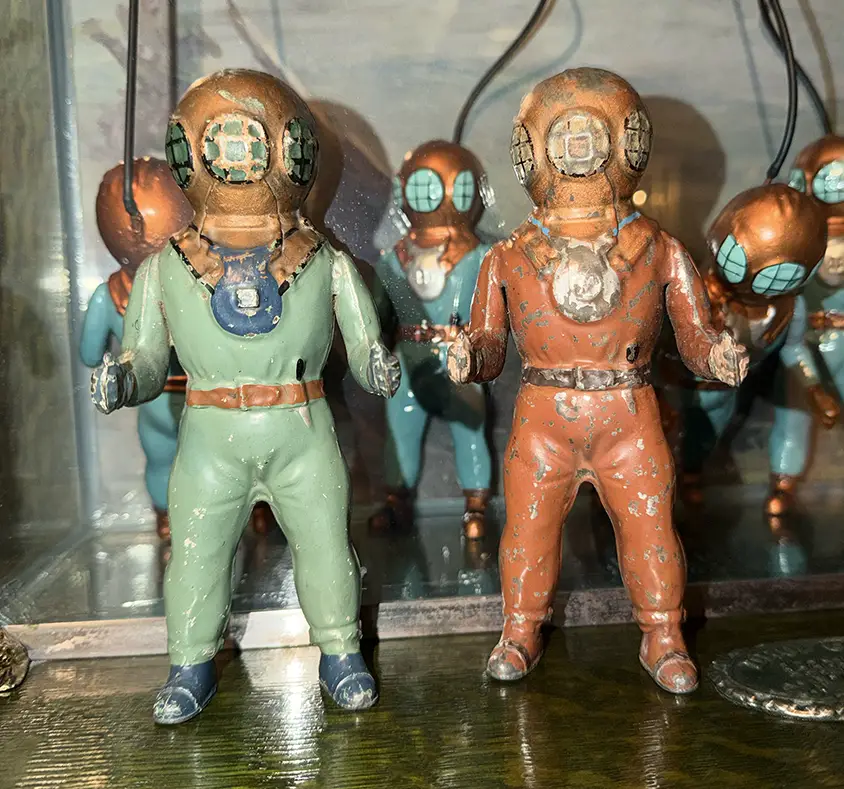
Shipley’s own machine also had an elaborate diorama inside the tank. It held china mermaids, sea shells, colored fish, crabs, lobsters, and sunken ships. There was also a “submarine castle” with miniature mermaids seated around it. Each of its five divers wore a different color of enamel: red, green, bright red, orange, and blue.
Collectors still debate who made the divers, and over the years they have credited several German toy firms, including Gebrüder Bing. However, the strongest evidence points to Ernst Plank of Nuremberg. For example, an auction listing showed a matching diver in its original Plank box.
Lettering across the top panel of the cabinet posed the challenge: “How Many Divers Can You Bring to the Top?”

Why No Original Mills Submarine Lung Tester Survives
In the 1910s, tuberculosis fears led many places to ban or restrict lung testers. Because every player blew into the same metal mouthpiece, these machines were an obvious way to spread disease. As a result, pressure mounted on operators to remove them, and most owners likely destroyed or scrapped their Submarine Lung Testers.
However, some operators worked around the ban by supplying waxed paper mouthpiece covers as a sanitary measure. Barton Shipley’s Chicago arcade did exactly this in 1928. Still, this only delayed the inevitable.
By the 1940s, collectors already considered the machine a near-mythical collectible. Famed Chicago collector Alden Scott Boyer placed a 1940 Chicago Tribune ad specifically asking to buy one for his coin-op museum. Still, there is no record that he ever found one. His collection passed to Al Svoboda’s Nickelodeon Tavern in the mid-1950s. In the 1980s, Svoboda’s collection scattered to the Sanfilippo Estate, House on the Rock, and private collectors. No Submarine Lung Tester appeared in either provenance trail.
What We Know From the Historical Record
The most detailed surviving descriptions come from a small handful of period sources:
- February 1928 — Automatic Age magazine, “Married Men Are Safe in Shipley’s Arcade” by O.C. Lightner.Lightner visited Shipley’s Automatic Fun Palace in Chicago and reported that the Submarine Lung Tester took in $12–$15 every Sunday. He called it a “marine diving machine” and noted Shipley’s claim that it was “the only one in existence” — even in 1928.
- June 1928 — Automatic Age magazine, “A Visit To Shipley’s Automatic Fun Palace” by Barton W. Shipley.Shipley’s first-person description of his own machine remains the single most detailed account ever published of an original cabinet, paint finish, and tank contents.
- October 1929 — Automatic Age classifieds. Joe Bousigusie of St. Louis listed a “Diver Blower” among machines he was selling as he retired from the penny arcade business.
- December 1929 — Automatic Age classifieds. Mark Holmes of Bridgeport, Connecticut, listed “1 Mills submarine blower, 25 cents” for sale.
- February 1940 — Automatic Age magazine, “Boyer’s Museum: The World’s First Collection of Historical Coin Devices” by Alden Scott Boyer. Boyer’s account of his Chicago Tribune ad seeking the machine.
In short, these five data points make up the entire public history of original machines. Consequently, any further sighting after 1940 would be a major discovery.
Mills Submarine Lung Tester Reproductions: How to Tell Them Apart
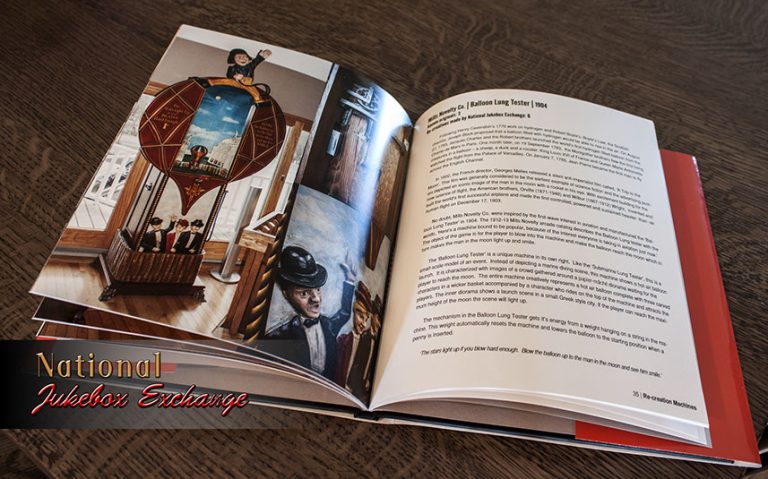
In the mid-2000s, National Jukebox Exchange and Arcade Treasures produced a prototype and 12 production reproductions of the Mills Submarine Lung Tester. The team recreated it from period catalog renderings, advertisements, and the Shipley descriptions. John Papa and his team built them, and collectors now consider them the definitive recreations of the machine.

Have a machine that resembles the Mills Submarine Lung Tester? Here’s how to tell an original from one of these modern reproductions:
- Look for the J. Papa stamp. Most NJE reproductions carry the J. Papa logo inside the cabinet, plus other hidden markings we can verify from photos.
- Cabinet finish. The reproductions use a green stain finish meant to evoke algae, unlike the green crackle over red lacquer Shipley described on his machine.
- Front mermaids. On the reproductions, the front mermaids are not metal, unlike the ones Shipley described.
- Castings. Reproduction castings often show softer, less crisp detail than originals. Original metal hardware also shows a century of oxidation, paint loss, and wear that’s hard to fake.
- The divers. Originals are early 1900s German tin toys. The reproduction divers are cast iron and at least twice as heavy.
- Provenance documentation. An original would almost certainly come with some chain of family or collector ownership — a barn find, an estate, an old arcade liquidation.
If you’re still not sure, send us photos. Because we built the reproduction run, we can usually tell within minutes.
What an Original Mills Submarine Lung Tester Could Be Worth
The closest comparable for valuing a hypothetical original Submarine Lung Tester is the Mills Lion Lung Tester. It is a similar circa-1904 Mills lung-test machine that survived in slightly greater numbers.
In May 2025, a Mills Lion Lung Tester sold at Morphy Auctions in Las Vegas for $184,500. The auction catalog described it as “one of only two known examples,” with documented 50-plus-year provenance. The estimate was $150,000–$300,000.
A confirmed original Mills Submarine Lung Tester (none has surfaced publicly) would draw the same elite Mills coin-op buyer pool, plus every collector who has spent decades hunting one. In fact, a reasonable upper bound is anyone’s guess. Therefore, any serious owner should get a professional appraisal and reach the right buyers before selling privately.
For reference, the mid-2000s John Papa reproductions trade in the $15,000–$22,000 range.
What to Do If You Have One
If you, a family member, or an estate you’re handling owns what appears to be an original Mills Submarine Lung Tester, here is the process we recommend:
- Don’t touch it. Don’t clean it, repaint it, or remove parts. After all, original finish is a major part of the value.
- Don’t fill the tank. A century-old tank seal is unlikely to hold water, and you risk damaging the diorama.
- Photograph it. Wide shots, close-ups of the cabinet finish, the metal mermaid and dolphin ornaments, the divers, the top panel, and any maker’s marks or serial numbers.
- Document the provenance. Family stories, old photos, arcade liquidation paperwork — anything that helps establish the chain of ownership.
- Contact us before you list it anywhere. A machine like this can lose significant value if it hits eBay or a regional auction house unprepared. The right buyers need to know it exists.
National Jukebox Exchange Is Actively Buying
As one of the original co-producers of the only modern recreations we know of, we have spent more than two decades documenting this machine’s history. If you believe you have an original Mills Submarine Lung Tester, we want to hear from you.
We pay top dollar for confirmed originals and can also help with:
- Authentication and identification
- Connecting you with major auction houses if private sale isn’t right for your situation
- Buying or selling the John Papa / NJE / Arcade Treasures reproductions
- Original tin divers, even without the cabinet
- Period Mills Novelty Company catalogs, sales literature, and arcade ephemera
Call: 888-321-7272 · Email: johnpapa1080@gmail.com · Website: nationaljukebox.com
All inquiries are confidential. We answer every message about a possible original within 24 hours.