How to Identify Any Vintage Jukebox: A Complete Guide
Have you just inherited an antique or vintage jukebox that you don’t know anything about? Does a family member have an old jukebox they want to get rid of and you don’t know the first thing about selling it? Maybe you’re wondering, “What kind of jukebox do I have?” or “What is my jukebox worth?” We’ve made a handy guide on how to identify your vintage jukebox and figure out exactly what you’re looking at.
Jukebox Brand Names
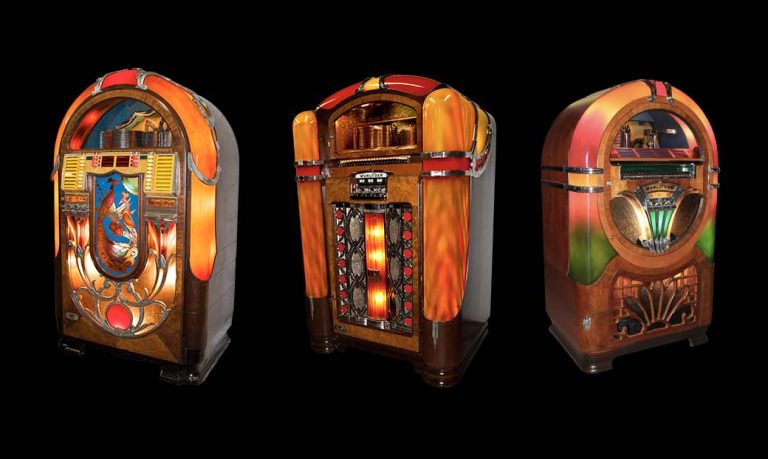
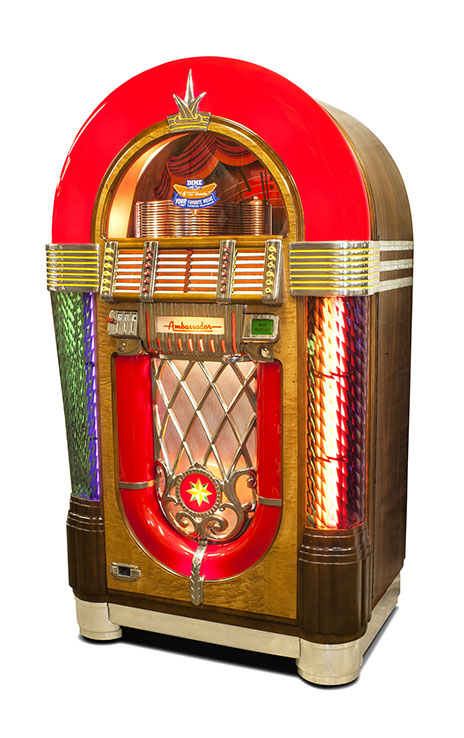
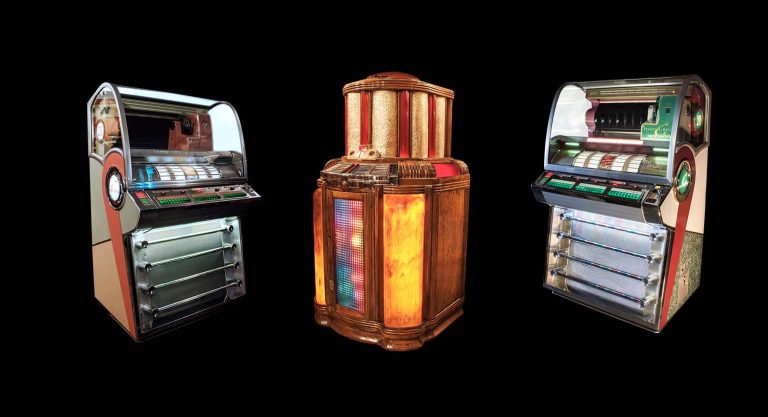
The first thing you’ll want to look for when trying to identify your mystery jukebox is who manufactured it. Through the decades, there have been many makers of coin-operated phonographs and jukeboxes, and some certainly lasted more than others. The major brands of jukeboxes — known in the hobby as “The Big Four” — consist of Wurlitzer, Rock-Ola, Seeburg, and AMI/Rowe.
Of these original manufacturers, only Rock-Ola continues to produce new jukeboxes today, operating out of Torrance, California. The Wurlitzer name lives on through reproduction models, but the original American company ceased jukebox production in 1974. Seeburg closed its doors in the 1980s, and AMI/Rowe shifted to digital jukebox networks. All of these companies have left a remarkable impact on the history of not only coin-operated amusements, but music in general.
Beyond the Big Four, there were also lesser-known jukebox manufacturers including Mills, Filben, Packard, Capehart, and Gabel, among others. Machines from these makers are considerably rarer and can be quite valuable to collectors.
Brand names are never hard to find, with the exception of obscure machines made by manufacturers that didn’t last very long. Brand names or maker marks are typically in and around the front of the machine — whether that is on the top valance, in the grill, or on the title board or mech cover.
How to Find the Model Number on a Jukebox
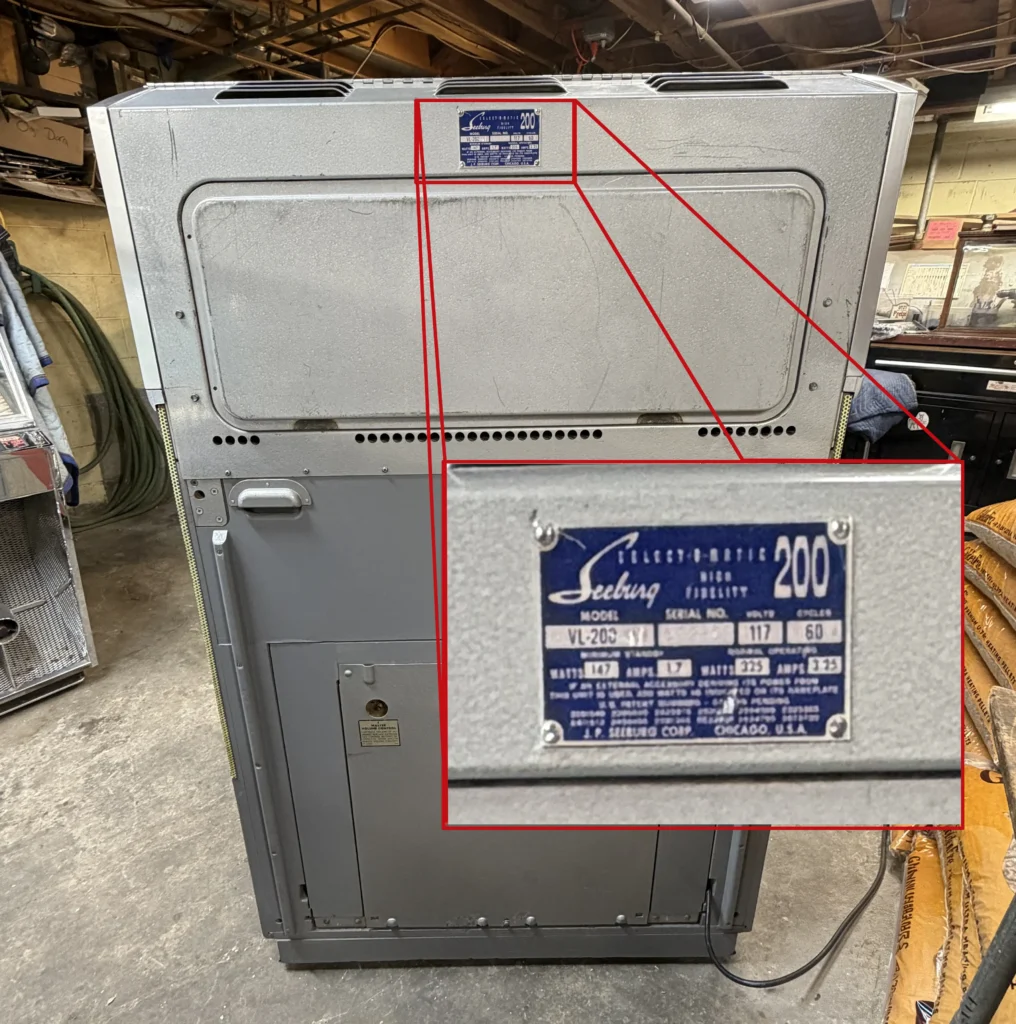
The key to identifying any jukebox is the model number. Nine times out of 10, the model number can be found on the back of the machine on a small silver or brass rectangular metal tag, most times towards the top of the machine. In rare cases, these tags may be missing.
If the model tag is missing, you can often identify a jukebox visually by comparing it to reference photos in an archive. Our Coin-Op Archive at National Jukebox Exchange has photos and details on hundreds of models from every major manufacturer.
Jukebox Serial Numbers
Something that will most likely not help very much in identifying a vintage jukebox is the serial number. The primary use of a serial number is to keep track of production numbers and sometimes serve as a type of “product registration.”
While some jukeboxes like earlier Wurlitzers can be identified by their serial number — Wurlitzer used a continuous serial number system through some of the earlier decades — this won’t work for every brand or model.
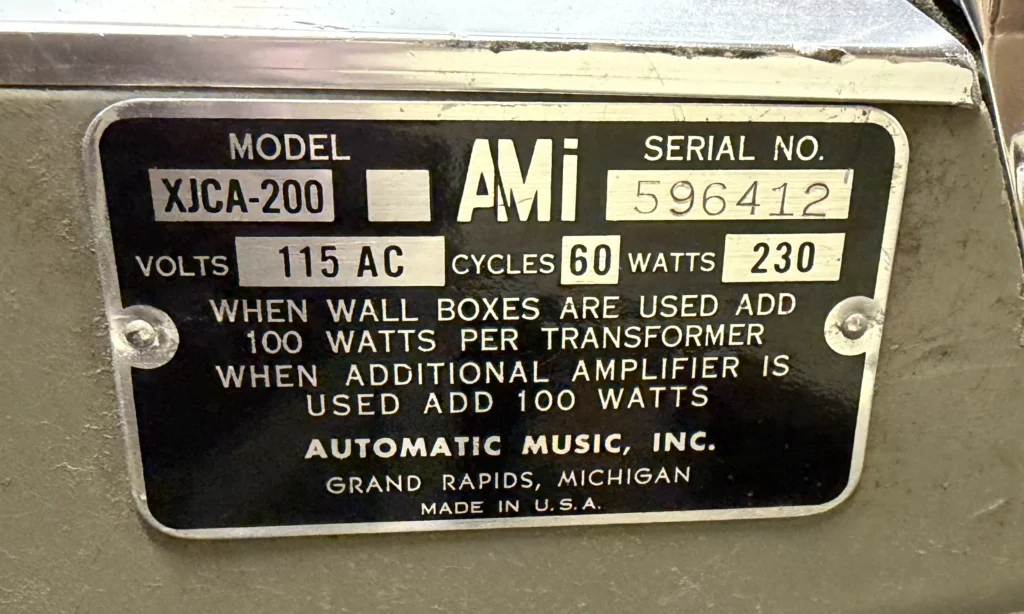
The serial number is typically found on the same metal plate as the model number, on the back of the jukebox near the top of the machine.
Get a Free Jukebox Appraisal from an Expert
If you have a jukebox that you are looking to identify, value, or sell, National Jukebox Exchange offers free expert appraisals. Fill out the form below for a free appraisal. With over 35 years of hands-on experience, founder John Papa has the expertise to give you the clearest picture of your machine’s identity and value.
We buy vintage jukeboxes nationwide in any condition and pay all shipping costs. Call us at (518) 774-5131 for a free appraisal, or fill out our online appraisal form to get started.